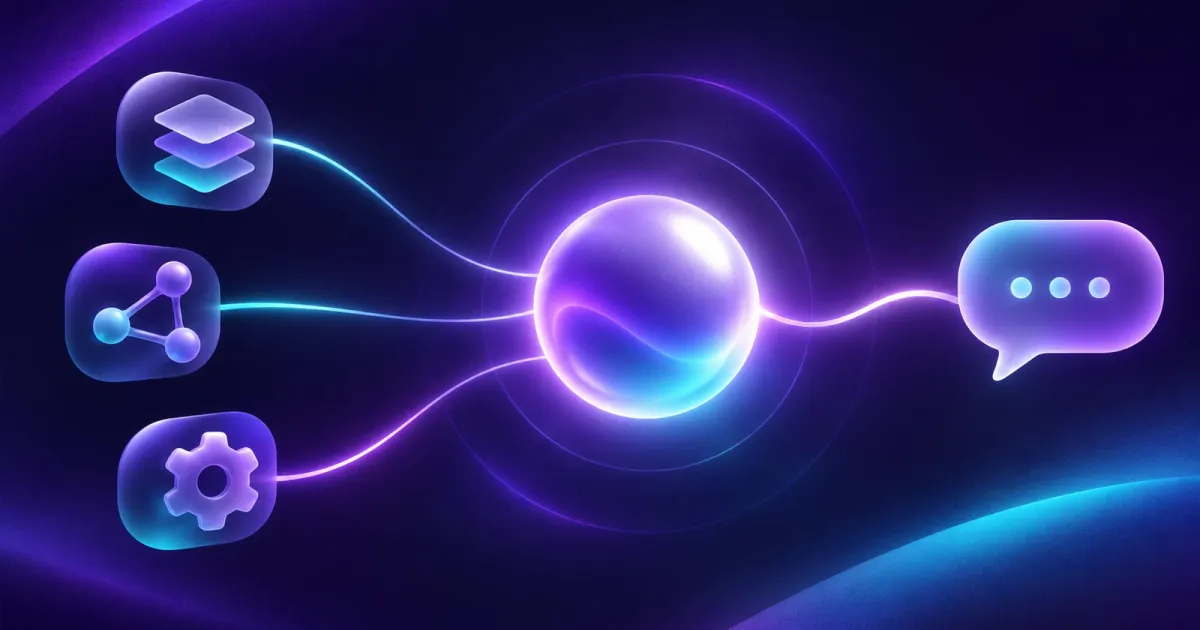
My coding agents finish things while I’m doing something else. A deploy goes live, a background job finds a problem, an agent finishes researching a question. I want those events to reach my always-on ChatGPT dot so it can decide what to do next with the context and tools it already has.
The obvious answer was to launch another agent. But that would give me another memory, another set of tools, and another place where context could get out of sync. I didn’t want a new assistant. I wanted an MCP-capable agent, or even a plain script, to send a message to the dot I already use.
dm-dot is that narrow connection. A coding agent calls one MCP tool, send_to_dot. A backend script can make an authenticated REST request. Both become the same message.created event delivered to the one ChatGPT dot subscribed to this deployment.
One message in, no second model in the middle
The service doesn’t run an LLM, ask OpenAI’s API to generate a response, or create a new ChatGPT conversation. It just accepts a message, finds the active subscriber, and sends a signed webhook to ChatGPT. The dot handles that event using its own existing permissions, tools, and workflow.
The two entry points are deliberate. MCP is natural when the sender is another assistant; REST is easier when the sender is a GitHub Action, a Go program, or a deployment script. They use different credentials but converge on one validated message path. A 16 KiB input limit keeps it a messaging primitive rather than a file-transfer protocol. For files and durable handoffs between agents, I already have Agentbox.
Events needed more than a tool definition
ChatGPT needs to know that this MCP server can emit events, not just respond to tool calls. The Go MCP SDK didn’t expose the Events capability I needed in its typed server schema, so I added a compatibility layer that advertises it through both the older initialize handshake and MCP 2.0’s server/discover path. The server implements events/list, events/subscribe, and events/unsubscribe alongside the normal tool endpoint.
Subscription is a real handshake. ChatGPT supplies a callback and a webhook-signing secret; dm-dot validates the HTTPS destination, sends a signed challenge, and only stores the subscription if the receiver echoes that challenge correctly. Redis holds one subscriber, its signing secret, and an expiration. I don’t store message bodies or a history of conversations in the bridge.
Each outgoing event gets a stable event ID and Standard Webhooks HMAC signature. Transient failures get up to three attempts with the same ID, so a receiver has something to deduplicate. The protocol documentation describes the exact boundary: an HTTP 2xx means ChatGPT accepted the webhook. It doesn’t mean my dot has started the task, finished it, or succeeded.
The small scope is the point
There is one subscribed dot per deployment and one-way delivery. No replies, no message history, no durable outbox, no multi-tenant user accounts, and no promise of exactly-once execution. Messages are untrusted input to the receiving dot, not instructions that bypass its approval rules. I made those boundaries explicit because a little tool that can wake an always-on agent can become a much bigger security problem if it quietly pretends to be an orchestration system.
Most of my tools exist to remove an annoying handoff. Agentbox moves documents and context between agents; dm-dot moves a nudge to one agent that can act on it. That’s all I needed, and keeping it that small is what makes it useful.