One of my agents is named silk spider. Another is blue plum. Earlier this week, distinct scorpion integrated a feature branch after two other agents sorted out a merge conflict over DMs. If you’re the kind of engineer who bristles at this, thinking they’re matrix multiplications and I should stop pretending they’re people, I understand the instinct, and I want to argue against it anyway. Everything in my stack treats agents as colleagues: names, roles, teams, messages, onboarding, even a rule about going home at the end of a shift. None of it is whimsy. Anthropomorphism, applied deliberately, is one of the highest-leverage engineering tools I have.
Titles steer, names address
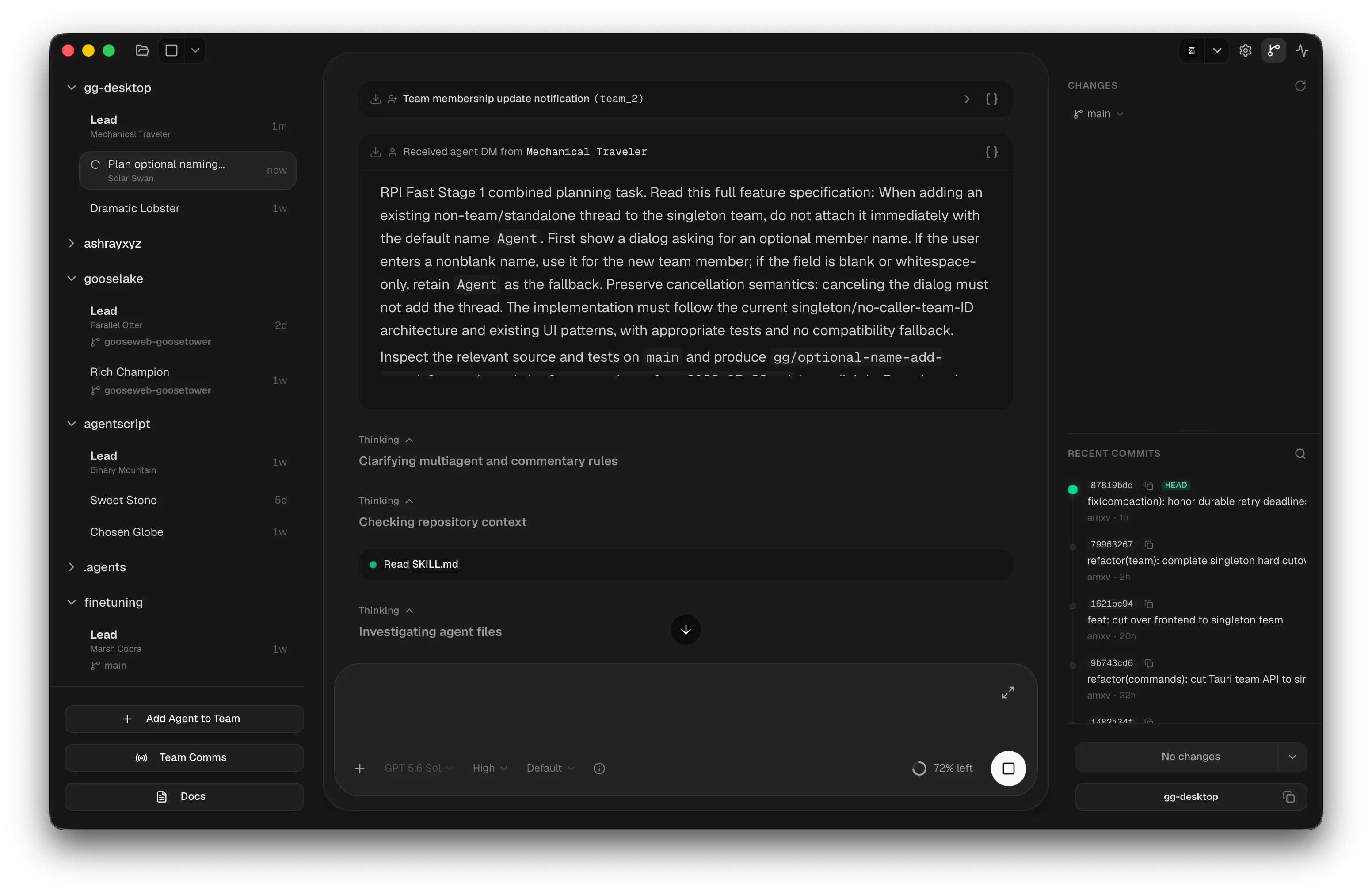
Start with the identity system, which looks decorative and isn’t. Every agent in goldengoose carries two labels, and the UI shows them in a deliberate order: a title first (Reviewer, Phase 2 Implementer, Feature Supervisor), and below it a random adjective-noun name like silk spider or blue plum. They do different jobs, and the ordering reflects which one matters more.
The title is behavioral. Handing a context the word reviewer tilts its whole trajectory toward a different way of reading the same code than implementer does, before a single instruction arrives. So the role is usually how I address agents too, because saying “reviewer” keeps that steering active. Titles are also optional and fluid: an agent outside any team has no role at all, and one can change hats mid-life.
The name is for addressing, and it earns its keep the moment titles stop being unique. One reviewer is “the reviewer”; run three review agents in the same repo and none of them is special anymore. That’s when “send this to silk spider and ask them to integrate into main” becomes the only unambiguous sentence available. Names don’t steer behavior; they make individuals reachable, for me and for the agents messaging each other through the same interface. IDs could do the routing half. They cannot do the half that runs on a human brain that evolved to track individuals, not UUIDs, which matters more than it sounds when you talk to a couple dozen of them a day.
The prompt and the priors meet at the office
The deeper reason the workplace metaphor works is the census argument again, pointed at behavior instead of file paths. The training data isn’t just millions of codebases; it’s millions of descriptions of people collaborating on them: code review etiquette, standup norms, handoff emails, “don’t ping me, I’ll ping you.” Human collaboration is massively in-distribution. So when my skills say review the diff like a senior engineer, those six words carry a thousand behaviors I never have to specify: check edge cases, mind the tests, be concrete in feedback, don’t nitpick style. When an assignment says DM your supervisor when done, and don’t check in before that, it lands on a lifetime of read behavior about not bothering colleagues mid-task.
A bespoke coordination protocol with message types, state enums, and escalation codes would be out-of-distribution, taught from scratch, in tokens, forever. The office is already in there. The metaphor isn’t a skin over the machinery. It’s the compression format the machinery natively decodes.
The other side of the interface is me
Anthropomorphism has a second consumer, and it’s not the model. Every management instinct our species has spent a century refining became directly applicable to my infrastructure the moment I framed agents as teammates. Delegate outcomes, not implementations. Give people role clarity. Don’t interrupt deep work. Route a conflict to the two people who own it, not to a stranger. Write an onboarding doc. Never make one person the chokepoint for information.
I didn’t have to invent an orchestration theory for multi-agent systems. I imported the working arrangement of human engineering teams, and it slotted onto the runtime almost without modification. That’s the quiet payoff of the metaphor: it makes my intuitions load-bearing too. When something feels wrong in the team’s dynamics, I can diagnose it with instincts I already had, instead of reasoning from first principles about a novel distributed system. It usually is the thing it feels like.
The dictionary of substitutions
What surprised me is how deep the mapping goes, provided you swap the right nouns. Fatigue is context depletion: the 65% rotation rule is “go home before you get sloppy,” enforced by a gauge. Amnesia is compaction, and the recovery procedure reads like instructions to a colleague who woke up mid-project: your notes are on disk, git is the witness, reconstruct from there. Onboarding is the spawn prompt, which is why goldengoose persists it as the canonical first message: the employee handbook you can reopen. Hiring is a tool call. Memory is not the brain at all; it’s the documents and the skills, which is more true of human teams than we like to admit. Working with a long-context lead feels like a colleague weeks into the job precisely because tenure was always mostly accumulated context.
Where the metaphor lies
A tool this sharp cuts back, so the discipline is knowing where the metaphor stops being true. Agents don’t learn between tasks: the brilliant implementer from yesterday is not wiser today, because there is no it that persisted overnight; only the files did. They don’t push back when confused the way a person eventually would; they plow ahead, confidently, which is why verifiers exist instead of trust. And they have no feelings to spare, which means several correct behaviors would be monstrous applied to people: my team hygiene rules remove finished implementers immediately, no farewell, and RPI Fast deletes the entire implementation crew before the reviewer arrives so the review starts cold. The sentimental error runs the other direction too: keeping an agent around because continuity feels valuable, when what you’re preserving is a bloated context window, not a relationship.
So the position isn’t “agents are people” and it isn’t “stop pretending.” It’s that the metaphor is an interface, not an ontology. Both endpoints of my system, the model’s priors and my own instincts, were trained on the same corpus of human collaboration, and speaking to each in that shared language is the cheapest reliable API I’ll ever get. silk spider is not a person. But addressing it like one compresses a thousand instructions I’d otherwise write by hand, and I’ll take a metaphor that ships over a taxonomy that doesn’t.